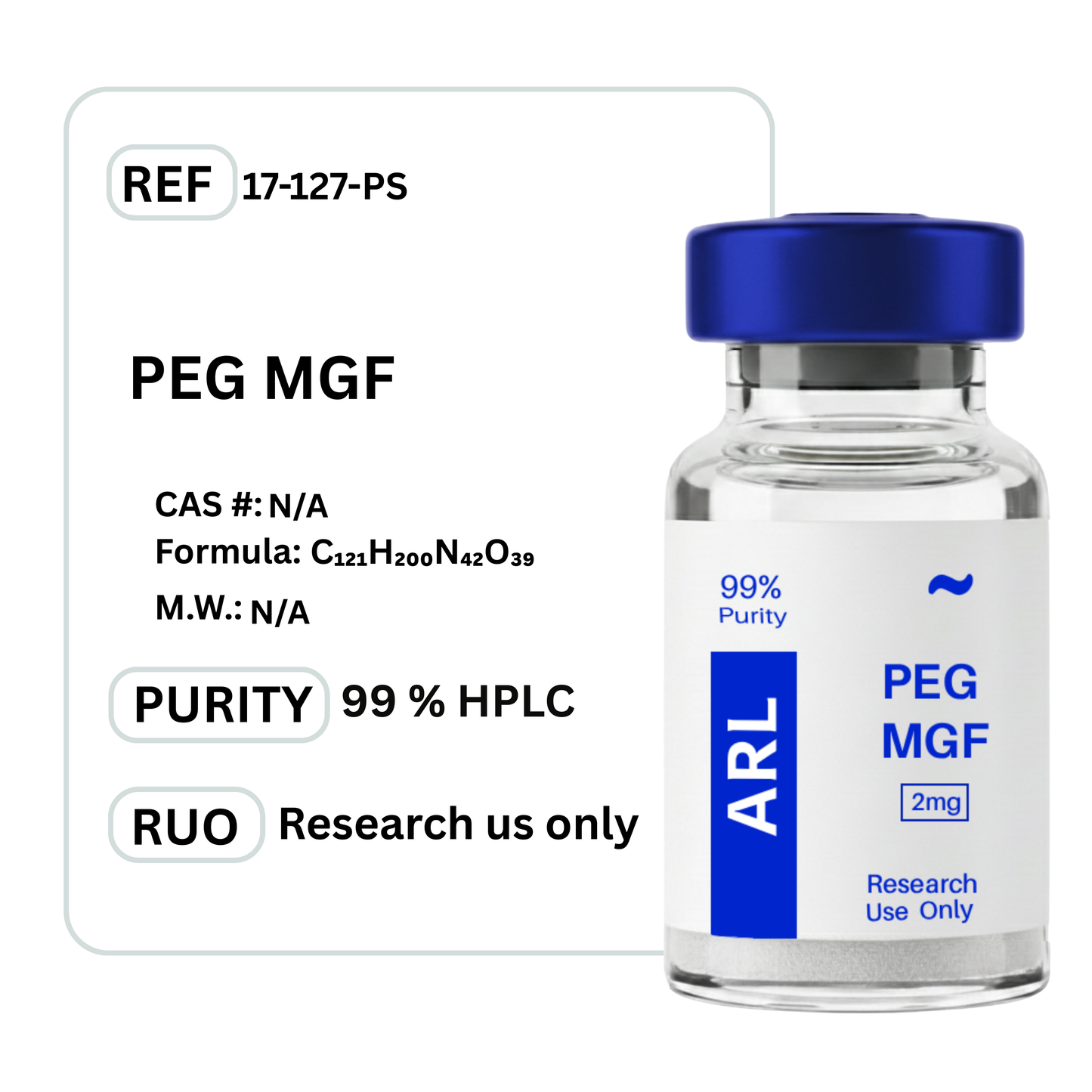
PEG MGF
PEG MGF
This batch of PEG MGF Peptide has been third party lab tested and verified for quality.
Contents: PEG-MGF (Pegylated Mechano Growth Factor, IGF-1 Splice Variant)
Form: Powder
Purity: 99.3%
Couldn't load pickup availability
Free Reconstitution Solution automatically added to your cart with each order.
This product is Made, Tested & Shipped From Canada.
Ships Today
Order by 1:00 PM EST
Free Shipping
For 2 or more vials
Verified+

Neuroprotective Research Peptide: A Review of its Potential in Neuronal Survival and Stroke Models
Executive Summary
The Neuroprotective Research Peptide (NRP), a pegylated analog of the naturally occurring peptide, exhibits significant promise in the field of neuroscience research, particularly concerning neuronal survival and stroke pathology. Similar to its parent molecule, Muscle Growth Factor (MGF), the PEG modification is hypothesized to enhance systemic delivery and stability, making it an attractive compound for in vivo and in vitro studies. Preliminary research contexts suggest its critical role in mitigating damage during cerebral ischemia and promoting neurogenesis, especially in aging and damaged neural tissues. This document summarizes the current research focus, ideal applications, and necessary restrictions for its use.
I. Introduction to the Neuroprotective Research Peptide (NRP)
The Neuroprotective Research Peptide is a synthetic research compound developed to explore neuroprotection, an area of critical need in stroke and neurodegenerative disease research. It is a pegylated derivative, designed to improve pharmacokinetics and distribution within the central nervous system (CNS) compared to the native, unmodified peptide.
A. Background of Native Peptide Analog
The native form, related to MGF (Mechano Growth Factor), is a splice variant of Insulin-like Growth Factor 1 (IGF-1). While MGF is primarily known for its regenerative effects on muscle tissue, its expression in the brain following injury suggests an inherent neurobiological role. The MGF E-domain is thought to modulate cellular processes like survival, apoptosis, and proliferation in neural stem cells.
B. The Pegylation Advantage
Pegylation, the covalent attachment of polyethylene glycol (PEG) chains, is a common pharmaceutical strategy used to:
- Increase the hydrodynamic size of the peptide, which can reduce renal clearance and prolong plasma half-life.
- Reduce immunogenicity.
- Enhance systemic stability, which is crucial for peptides intended for delivery to neural tissues.
In the context of the NRP, the PEG modification is specifically engineered to allow for better systemic delivery to neural tissues, a critical factor given the challenge of the blood-brain barrier (BBB).
II. Research Context: Investigating Global Ischemia (Stroke Models)
Cerebral ischemia, commonly known as stroke, leads to rapid neuronal cell death due to a lack of oxygen and nutrients. Ischemic damage occurs in two phases: the core, where blood flow is severely reduced and cell death is immediate, and the penumbra, the surrounding area where cells are metabolically compromised but potentially salvageable.
A. Focus on Ischemic Neuroprotection
The NRP is being actively investigated for its potential to protect neurons within the ischemic penumbra, thereby reducing the final infarct size and improving functional outcomes in stroke models.
Key mechanistic hypotheses under investigation include:
- Anti-Apoptotic Signaling: Activation of cell survival pathways, such as the PI3K/Akt pathway, which can inhibit pro-apoptotic factors (e.g., Caspases).
- Mitochondrial Stabilization: Preservation of mitochondrial function, a primary target of ischemic injury.
- Reduction of Excitotoxicity: Potential modulation of glutamate receptor signaling to limit calcium overload, a major contributor to neuronal death.
B. Experimental Models of Ischemia
Research involving NRP typically utilizes established animal models of stroke to mimic human pathophysiology.
Model Type
Focus Area
Description
Global Ischemia
Hippocampal Damage
Models cardiac arrest, leading to widespread but transient ischemia, primarily affecting vulnerable regions like the CA1 hippocampus.
Focal Ischemia
Cortical/Striatal Damage
Models thrombotic/embolic stroke, typically via Middle Cerebral Artery Occlusion (MCAO), creating a defined core and penumbra.
In Vitro Models
Cellular Mechanisms
Oxygen-Glucose Deprivation (OGD) on primary neuronal cultures, used to dissect molecular pathways.
C. Preliminary Findings on NRP Efficacy
Early research has shown that administration of NRP following an ischemic event in global ischemia models results in a measurable increase in viable neurons in the CA1 region of the hippocampus compared to control groups. This suggests a direct neuroprotective effect against the delayed cell death observed in this model.
III. Research Context: Neurogenesis and Brain Repair
Neurogenesis, the process of generating new neurons, primarily occurs in two regions of the adult mammalian brain: the subgranular zone (SGZ) of the dentate gyrus in the hippocampus and the subventricular zone (SVZ). This process is severely impaired in aging and is often compromised following neural injury.
A. Promotion of Neurogenesis
Research suggests that the NRP may promote the generation of new neurons, particularly in the aging brain. This potential therapeutic avenue distinguishes it from compounds that only mitigate acute injury.
Mechanisms hypothesized to be involved in neurogenic promotion:
- Stem Cell Proliferation: Stimulation of quiescent neural stem cells (NSCs) in the SVZ and SGZ to enter the cell cycle and divide.
- Differentiation: Guiding newly born cells towards a mature neuronal phenotype rather than glial cells.
- Survival of Progeny: Enhancing the long-term survival and integration of new neurons into existing neural circuits.
B. Application in Aging and Neurodegeneration
The decline in cognitive function associated with aging and neurodegenerative diseases (e.g., Alzheimer's disease, Parkinson's disease) is often correlated with reduced neurogenesis. The NRP offers a research tool to investigate whether augmenting the endogenous neurogenic capacity can ameliorate cognitive deficits.
The table below outlines common research models where NRP's neurogenic potential is explored:
Model
Target Area
Research Question
Aged Rodent Models
Hippocampus
Can NRP restore age-related decline in neurogenesis and improve spatial memory?
TBI/Contusion Models
Perilesional Area
Can NRP enhance repair mechanisms and functional recovery after traumatic brain injury?
Disease Models
Affected CNS Region
Does NRP's action on NSC promote resilience or repair in models of Person's Disease?
IV. Efficacy: Systemic Delivery and Pharmacokinetics
The PEG modification is a core component of the NRP's design, fundamentally impacting its efficacy through enhanced systemic delivery. Achieving therapeutic concentrations of peptides within the brain is a significant hurdle for neuroscience research.
A. Improved Systemic Delivery
The efficacy is significantly enhanced by the PEG modification, which improves the systemic delivery to neural tissues compared to the native, non-pegylated MGF.
Feature
Native Peptide
Pegylated NRP
Plasma Half-Life
Short (Minutes)
Extended (Hours to Days)
Renal Clearance
High
Reduced
Systemic Stability
Low
High
Distribution to CNS
Challenging
Improved (Due to prolonged plasma exposure)
B. Dose-Response and Administration Routes
Investigators use NRP to determine the optimal dose and route of administration for achieving desired outcomes (e.g., maximum neuroprotection or neurogenesis). While subcutaneous (SC) or intraperitoneal (IP) injection is feasible due to the enhanced stability, researchers also utilize intraventricular or direct brain injection for maximum target engagement in some specific studies.
C. Bioavailability and Receptor Interaction
Research protocols often involve measuring the concentration of NRP and its metabolites in the brain tissue using techniques like high-performance liquid chromatography (HPLC) coupled with mass spectrometry. This data is critical for correlating systemic dose with local biological effect (neuroprotection/neurogenesis).
V. Ideal Applications and Target Research Areas
The unique properties of the Neuroprotective Research Peptide make it ideally suited for specific research applications, primarily focused on central nervous system pathology and repair.
A. Ideal For: Neurodegenerative Disease Models
The NRP serves as a crucial tool for understanding cellular resilience and repair in the face of chronic neurological diseases.
- Modeling of Person's Disease: Used to investigate the preservation of specific neuronal populations (e.g., dopaminergic or cholinergic neurons) and the potential for promoting endogenous repair mechanisms.
- Amyotrophic Lateral Sclerosis (ALS) Models: Researching its role in protecting motor neurons from excitotoxicity and aggregation-induced stress.
- Chronic Ischemia/Vascular Dementia: Exploring the long-term effects of NRP on white matter integrity and cognitive function following repeated, sub-lethal ischemic insults.
B. Ideal For: Acute Stroke Research
In acute models of stroke, NRP is used to test the concept of a "therapeutic time window."
- Delayed Treatment Studies: Assessing how long after an ischemic event NRP remains effective in reducing infarct volume and improving functional deficits (e.g., motor function, behavior).
- Combination Therapies: Investigating the synergistic effects of NRP when combined with existing or experimental stroke treatments (e.g., thrombolytics, hypothermia).
C. Experimental Protocols Utilizing NRP
Below are examples of research questions that the NRP is ideal for addressing in a laboratory setting:
- How does NRP modulate the inflammatory response in the peri-infarct zone following MCAO?
- What are the downstream transcriptional changes induced by NRP in isolated neuronal stem cells?
- Does chronic NRP administration in a mouse model of accelerated aging (Date) lead to measurable improvements in cognitive assessment scores (e.g., Morris Water Maze)?
VI. Safety and Regulatory Considerations
The Neuroprotective Research Peptide is provided solely as a laboratory research tool. Strict adherence to safety protocols and regulatory guidelines is mandatory.
A. Restriction: Not for Human Therapeutic Use
THE NRP IS STRICTLY FOR RESEARCH USE ONLY AND IS NOT APPROVED FOR HUMAN THERAPEUTIC OR DIAGNOSTIC USE.
This restriction is in place because:
- Preclinical Status: The compound has not undergone the rigorous testing required for human clinical trials, including extensive toxicology and safety profiling.
- Unknown Long-Term Effects: The long-term systemic effects of the pegylated peptide in humans are unknown.
- Regulatory Compliance: Its use is limited to in vitro and in vivo research models by trained professionals in accredited research facilities.
B. Handling and Storage
The following guidelines must be followed to ensure the safety of personnel and the integrity of the research compound:
Parameter
Guideline
Storage
Lyophilized powder stored at -20°C. Reconstituted solution stored at 4°C for short periods.
Handling
Use appropriate personal protective equipment (PPE), including gloves, lab coats, and eye protection.
Disposal
Dispose of all peptide solutions and contaminated materials according to institutional biosafety guidelines and Place regulations.
VII. Future Research Directions
The current focus on neuronal survival and stroke models serves as a foundation for broader investigations into the NRP's biological functions.
A. Non-CNS Applications
While the primary focus is neuroprotection, the native peptide's role in muscle and tissue repair warrants further investigation of the NRP in non-CNS systems.
- Skeletal Muscle Regeneration: Assessing its potential to accelerate healing in models of severe muscle trauma.
- Cardiac Ischemia: Exploring potential protective effects on cardiac tissue post-myocardial infarction.
B. Structural Biology and Receptor Characterization
A key area of future research is to definitively characterize the mechanism of action. This includes:
- Receptor Identification: Confirming the specific receptor(s) through which the NRP exerts its neuroprotective and neurogenic effects.
- Binding Affinity Studies: Determining the binding kinetics of the pegylated versus the native peptide.
VIII. Conclusion
The Neuroprotective Research Peptide represents a significant research-grade compound for advancing understanding in neuronal survival and CNS repair. Its pegylated structure provides a key advantage for systemic delivery in stroke and neurodegenerative models. Researchers utilizing the NRP have the opportunity to make breakthroughs in understanding the endogenous mechanisms of neuroprotection and neurogenesis. All use must remain strictly within the confines of laboratory research, adhering to the restriction against human therapeutic use. The potential for the NRP to illuminate new pathways for treatment development is substantial.
For technical specifications, stability data, and detailed protocols, please refer to the accompanying File data sheet.
-
check_circle
HIGHEST QUALITY PEPTIDES
Our products are scientifically formulated and manufactured in cGMP-compliant facilities.
-
encrypted
FAST DELIVERY
Enjoy fast and reliable 3–5 day shipping.
-
check_circle
Dedicated Customer Service
Our customer service team is highly knowledgeable in peptide research and its applications. We’re available 24/7 to assist you.
Verified reviews
Tested. Verified. Trusted.
We take a laboratory-first approach to quality. Each batch is made under controlled conditions and verified by an independent lab (HPLC/MS). We only ship batches that test ≥99% purity, and we provide a full COA, including identity, methods, and chromatograms, for your review.
You may also like
-
SAVE 24%Thymosin Alpha-1
Regular price From $79.00Regular price From $79.00 Sale priceUnit price / per$104.0024% -
SAVE 23%Tesamorelin
Regular price From $80.00Regular price From $80.00 Sale priceUnit price / per$105.0023% -
SAVE 26%Sterile Water
Regular price From $14.00Regular price From $14.00 Sale priceUnit price / per$19.0026% -
SAVE 23%SLU-PP-332
Regular price $125.00Regular price $125.00 Sale priceUnit price / per$164.0023% -
SAVE 23%Sermorelin
Regular price From $70.00Regular price From $70.00 Sale priceUnit price / per$92.0023% -
SAVE 23%Retatrutide Triple Agonist
Regular price From $90.00Regular price From $90.00 Sale priceUnit price / per$118.0023% -
SAVE 26%Oxytocin Acetate
Regular price $42.00Regular price $42.00 Sale priceUnit price / per$57.0026% -
SAVE 25%Melanotan II (MT2)
Regular price $50.00Regular price $50.00 Sale priceUnit price / per$67.0025% -
SAVE 24%Lipo-C with B Vitamins
Regular price $85.00Regular price $85.00 Sale priceUnit price / per$112.0024% -
SAVE 23%Lemon Bottle
Regular price $80.00Regular price $80.00 Sale priceUnit price / per$105.0023% -
SAVE 23%L-Carnitine
Regular price $97.00Regular price $97.00 Sale priceUnit price / per$127.0023% -
SAVE 24%KPV Tripeptide
Regular price From $56.00Regular price From $56.00 Sale priceUnit price / per$74.0024% -
KLOW Blend - GHK-CU + TB-500 + BPC-157 + KPV 10mg
Regular price $200.00Regular price $200.00 Sale priceUnit price / per$261.0023% -
SAVE 23%Kisspeptin-10
Regular price From $65.00Regular price From $65.00 Sale priceUnit price / per$85.0023% -
SAVE 23%Ipamorelin
Regular price From $32.00Regular price From $32.00 Sale priceUnit price / per$42.0023% -
SAVE 24%IGF-1 LR3 (Long R3)
Regular price From $40.00Regular price From $40.00 Sale priceUnit price / per$53.0024% -
SAVE 24%Hyaluronic
Regular price $28.00Regular price $28.00 Sale priceUnit price / per$37.0024% -
SAVE 23%HGH Fragment 176-191
Regular price $97.00Regular price $97.00 Sale priceUnit price / per$127.0023% -
SAVE 23%HGH 191AA (Somatropin)
Regular price From $55.00Regular price From $55.00 Sale priceUnit price / per$72.0023% -
SAVE 25%Gonadorelin
Regular price $50.00Regular price $50.00 Sale priceUnit price / per$67.0025% -
SAVE 23%Glutathione
Regular price $83.00Regular price $83.00 Sale priceUnit price / per$109.0023% -
SAVE 23%Glow BPC-157 + GHK-CU + TB-500
Regular price $139.00Regular price $139.00 Sale priceUnit price / per$181.0023% -
SAVE 25%Epitalon (Epithalon)
Regular price From $50.00Regular price From $50.00 Sale priceUnit price / per$67.0025% -
SAVE 24%Dermorphin
Regular price $56.00Regular price $56.00 Sale priceUnit price / per$74.0024% -
SAVE 23%CJC-1295 with DAC
Regular price $139.00Regular price $139.00 Sale priceUnit price / per$182.0023%
Every vial we sell comes from a lab that follows current Good Manufacturing Practices (cGMP). That means each step of production is documented and controlled. Before a batch is released, it’s tested by independent third-party labs for purity, identity, and sterility. Certificates of analysis are available so you can see the exact test results.
Yes. The labs we work with use ISO-certified clean rooms where air quality, equipment, and handling procedures are tightly regulated. Staff are trained to pharmaceutical-grade standards. This ensures the peptides are produced in an environment that minimizes contamination risks.
Peptides in lyophilized (freeze-dried) form are stable at room temperature for transport. Once you receive them, refrigeration is recommended to maintain long-term integrity. We package every order securely to prevent damage and ship promptly, so your vials arrive in optimal condition.
We operate under strict in-house protocols that follow current Good Manufacturing Practices (cGMP). That means our team oversees the entire process from sourcing raw amino acids to the final lyophilized vial. Nothing is outsourced or repackaged. This gives us full control over purity, consistency, and sterility, and it’s why we can stand behind every single vial we ship.
Store them in the refrigerator, away from direct light and heat. If you need to keep them longer, some peptides can be stored frozen. Each vial comes with clear handling instructions so you know the proper conditions for stability.
The strongest proof is transparency. For every peptide, we can provide certificates of analysis, manufacturing documentation, and references to the published scientific research behind it. If you ever have questions, we’ll show you the data rather than ask you to take our word for it.
The difference is transparency. Most sites give you a product name and a price. We provide full batch testing, lab documentation, and direct access to certificates of analysis so you don’t have to guess what you’re getting. When you order from us, you know exactly what’s in the vial, where it was made, and how it was verified.