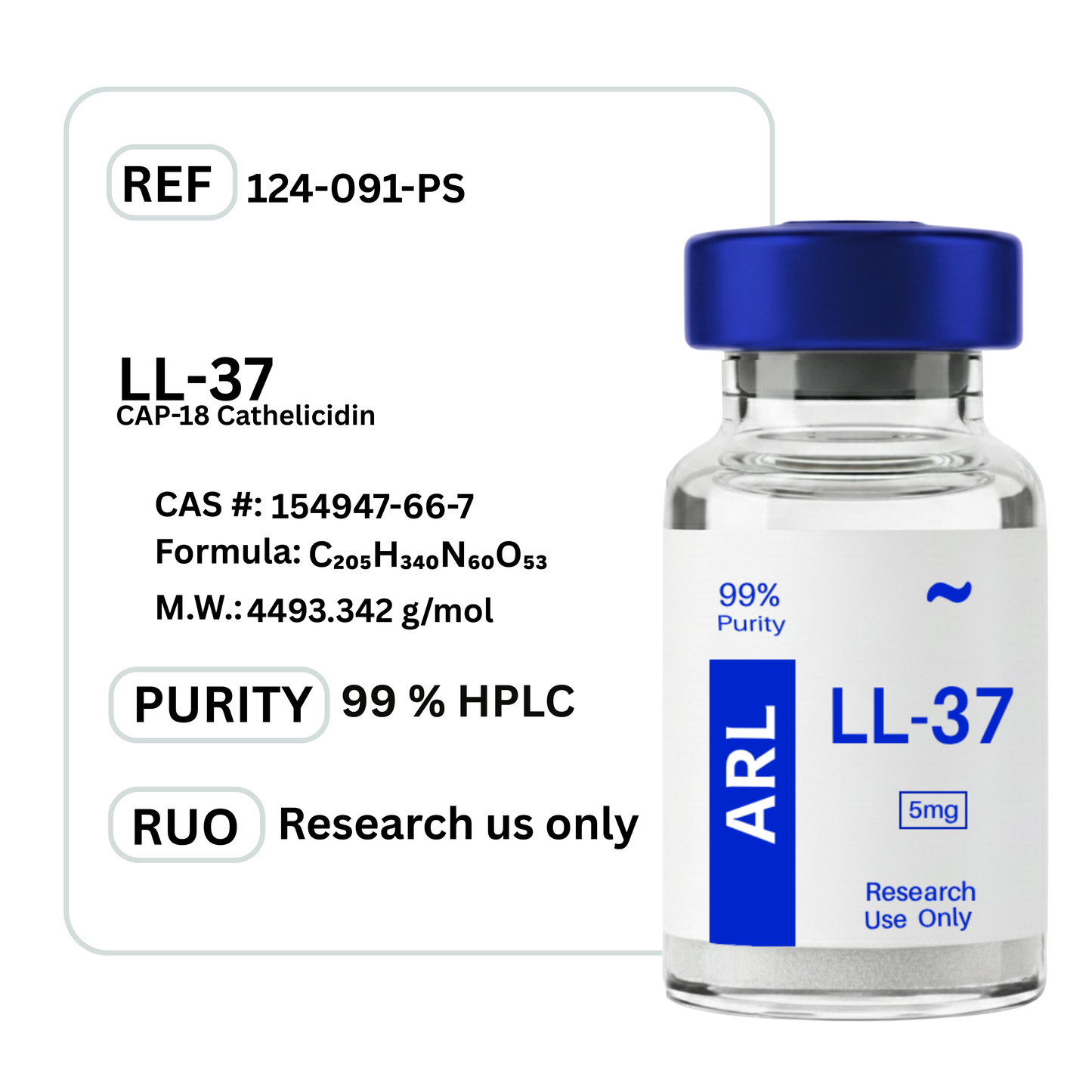
LL-37
LL-37
This batch of LL-37 Antimicrobial Peptide has been third party lab tested and verified for quality.
Contents: LL-37
Form: Powder
Purity: 99.3%
Couldn't load pickup availability
Free Reconstitution Solution automatically added to your cart with each order.
This product is Made, Tested & Shipped From Canada.
Ships Today
Order by 1:00 PM EST
Free Shipping
For 2 or more vials
Verified+

Scientific Background: Autoimmune Inflammation Probe
1. Introduction to the Autoimmune Inflammation Probe (AIP)
The Autoimmune Inflammation Probe (AIP) is a novel research product focused on investigating the intricate molecular mechanisms underpinning Rheumatoid Arthritis (RA) and Systemic Lupus Erythematosus (SLE), commonly known as lupus. Both RA and lupus are chronic autoimmune diseases characterized by systemic inflammation and tissue damage, mediated by a breakdown in immune tolerance.
The AIP is specifically designed for in vitro autoimmune assays, offering researchers a controlled tool to examine the regulatory and pathogenic roles of key endogenous molecules in these disease models.
The primary focus of the AIP's scientific background is the cathelicidin antimicrobial peptide, LL-37, a molecule with a complex and context-dependent role in both innate immunity and autoimmunity.
2. Scientific Background: LL-37 in Autoimmunity
LL-37, the human cathelicidin antimicrobial peptide (CAMP), is ubiquitously expressed in neutrophils, epithelial cells, and other immune cells. While its primary role is in host defense, its dysregulation has been strongly implicated in the pathogenesis of various autoimmune diseases, particularly RA and lupus.
LL-37's involvement in autoimmunity is multifaceted, ranging from direct modulation of inflammatory signaling pathways to the formation of immunostimulatory complexes.
2.1. LL-37 and Rheumatoid Arthritis (RA)
In RA, LL-37 levels are notably elevated, particularly within the inflamed synovium of affected joints. The presence of LL-37 in this inflammatory milieu suggests a specific, albeit complex, role in joint pathology.
2.1.1. LL-37 Levels in Inflamed Joints
Elevated levels of LL-37 are consistently found in inflamed joints of RA patients. While initially, high concentrations of an inflammatory mediator might suggest a pathogenic role, current research suggests a nuanced interpretation.
Research suggests this may be a protective feedback mechanism to dampen inflammation rather than a causative factor of joint destruction. The localized increase in LL-37 could be a homeostatic attempt by the body to resolve the hyper-inflammation through its known immunomodulatory properties.
2.1.2. Regulation of Collagen Degradation
The destructive nature of RA is characterized by the degradation of articular cartilage, primarily mediated by matrix metalloproteinases (MMPs). LL-37 has been investigated for its ability to suppress collagen degradation in arthritic joint models.
This regulatory function supports the hypothesis that LL-37, in the context of RA, may act as a tissue-protective agent, counteracting the excessive proteolytic activity of inflammatory cells. Assays utilizing the AIP can help determine the optimal concentration and duration required for this suppressive effect on various cell lines (e.g., fibroblast-like synoviocytes).
3. LL-37 and Systemic Lupus Erythematosus (SLE)
The role of LL-37 in lupus is distinctly different from its potential modulatory role in RA, primarily revolving around its capacity to interact with self-nucleic acids and promote the activation of plasmacytoid dendritic cells (pDCs).
3.1. DNA Binding and Immunocomplex Formation
A critical finding in lupus pathogenesis is the ability of LL-37 to bind to self-DNA. This interaction is highly significant because it facilitates the formation of stable, soluble complexes.
In Lupus models, LL-37 binds to self-DNA, potentially forming complexes that activate Toll-like Receptors (TLR9) in dendritic cells. TLR9 is an endosomal receptor that typically detects bacterial and viral DNA. When activated by self-DNA complexed with LL-37, it triggers a robust interferon-alpha (IFN-$\alpha$) response.
Key LL-37 Interaction
Disease Context
Molecular Outcome
DNA Binding
Lupus (SLE)
Formation of LL-37/DNA complexes
TLR9 Activation
Lupus (SLE)
Induction of type I interferon production
Suppression of MMPs
Rheumatoid Arthritis (RA)
Reduced collagen degradation
3.2. Type I Interferon Signature
The activation of pDCs via the LL-37/DNA/TLR9 axis is central to the "Type I Interferon Signature" which defines a major subset of SLE patients. The AIP can be used to monitor this specific signaling cascade in pDC cultures, measuring IFN-$\alpha$ release in response to LL-37-complexed DNA.
4. Usage of the Autoimmune Inflammation Probe (AIP)
The Autoimmune Inflammation Probe is a standardized research tool for investigating the mechanisms described above. It is primarily intended for use in in vitro autoimmune assays.
4.1. Recommended In Vitro Applications
The AIP is suitable for a range of mechanistic studies, including:
- Dendritic Cell Activation Assays (Lupus Model): Investigating the dose-dependent activation of pDCs by LL-37 complexed with purified self-DNA. Assays should monitor TLR9 signaling and downstream IFN-$\alpha$ production via ELISA or gene expression analysis.
- Required materials: File and suitable cell culture medium.
- Synovial Cell Modulation Studies (RA Model): Examining the effect of LL-37 on matrix metalloproteinase (MMP) secretion (e.g., MMP-1, MMP-3, MMP-13) in fibroblast-like synoviocytes (FLS) cultured from RA patients. This helps assess the protective feedback mechanism.
- DNA-Binding Competition Assays: Using the AIP to study competitive binding dynamics between LL-37 and other autoantigens or nucleic acid-binding proteins.
- T-Cell Proliferation Assays: Evaluating the immunomodulatory role of LL-37 on T-cell responses in the presence of inflammatory cytokines.
4.2. Protocol Considerations
Optimal results are achieved when the AIP is utilized under defined conditions:
- Sterility: Maintain strict sterile conditions for all cell culture applications.
- Concentration Range: Start with a broad range of LL-37 concentrations (e.g., 0.1 $\mu$M to 10 $\mu$M) in preliminary studies to identify the effective concentration window for the specific cell line or primary cell type being used.
- Controls: Always include appropriate negative controls (vehicle only) and positive controls (e.g., high-dose IFN-inducing agent for pDCs).
5. Detailed Mechanistic Pathways
5.1. The Type I Interferon Cascade in Lupus
The TLR9 signaling pathway is critical in driving lupus pathology. When LL-37 encounters self-DNA (e.g., from apoptotic cells), it neutralizes the anionic charge of the DNA backbone, allowing the complex to be efficiently internalized by pDCs. This internalization directs the complex to the endosome where it is sensed by TLR9.
Activation of TLR9 leads to the recruitment of adaptor molecules, resulting in the activation of interferon regulatory factor 7 (IRF7). IRF7 then translocates to the nucleus to induce massive production of type I interferons, particularly IFN-$\alpha$. This sustained IFN-$\alpha$ production is highly correlated with disease activity in SLE patients.
5.2. Anti-Inflammatory Effects in RA
While the pathogenic role of LL-37 in lupus is clear, its action in RA is characterized by dual functionality. In addition to potential protective feedback, LL-37 also has documented anti-inflammatory properties that may attempt to limit joint damage:
- Chemokine Modulation: LL-37 can modulate the expression and release of various chemokines and cytokines, often dampening pro-inflammatory responses in a context-dependent manner.
- Apoptosis: It may influence the survival of immune cells, potentially promoting the clearance of inflammatory cells in the joint.
- Angiogenesis: LL-37 can affect local angiogenesis, a crucial process in the progression of synovial inflammation.
Further research using the AIP is necessary to fully dissect when and how the protective mechanisms of LL-37 switch or fail, leading to chronic RA.
6. AIP Specifications and Storage
The Autoimmune Inflammation Probe is provided as a lyophilized peptide for maximum stability.
Component
Description
Concentration (Post-Reconstitution)
Storage
Autoimmune Inflammation Probe (AIP)
LL-37 peptide
1 mg/mL (in recommended solvent)
-20°C (lyophilized), -80°C (reconstituted)
Reconstitution Solvent
Sterile water for injection
N/A
Room temperature
Certificate of Analysis
Lot-specific data and purity report
N/A
File
7. Future Directions in LL-37 Research
The complex nature of LL-37's role—pathogenic in lupus and potentially protective in RA—underscores the need for targeted research. The AIP is a foundational tool for addressing these unanswered questions:
- Conformational Changes: How does the tertiary structure of LL-37 change when binding to self-DNA versus when interacting with synovial cells, and how do these changes dictate functional outcome?
- Therapeutic Potential: Can modified versions of LL-37 be engineered to enhance its protective properties in RA while eliminating its pathogenic potential in SLE?
- Clinical Correlation: In clinical trials, does the local concentration of LL-37 in the synovium correlate with the effectiveness of anti-rheumatic drugs?
The AIP will support researchers in pursuing these directions, facilitating the development of novel diagnostic markers and therapeutic interventions for RA and lupus.
8. Summary of Key Targets and Mechanisms
The following table summarizes the primary mechanisms and cell types targeted by studies using the Autoimmune Inflammation Probe:
Disease
Primary Target Cells
LL-37 Mechanism
Receptor/Signal
Systemic Lupus Erythematosus (SLE)
Plasmacytoid Dendritic Cells (pDCs)
DNA Binding and Immunocomplex Formation
TLR9 Activation; IFN-$\alpha$ Production
Rheumatoid Arthritis (RA)
Fibroblast-Like Synoviocytes (FLS)
Suppression of Collagen Degradation
MMP Regulation; Potential Feedback Loop
9. Experimental Guidance: Optimizing In Vitro Assays
When using the AIP for the aforementioned assays, careful experimental design is crucial.
9.1. Handling and Reconstitution
Reconstitute the lyophilized AIP with the provided sterile water to achieve the recommended stock concentration. Aliquot the stock solution immediately upon reconstitution to prevent repeated freeze-thaw cycles, which can degrade peptide integrity. Store aliquots at -80°C. Dilute the working concentration only immediately before adding to cell cultures.
9.2. Cell Line Selection
For Lupus studies, immortalized human pDC cell lines or primary pDCs isolated from healthy donors or lupus patients should be used. For RA studies, primary FLS cultures from RA patients (not osteoarthritis or healthy controls) are highly recommended to ensure relevance to the disease state.
9.3. Data Interpretation
The context of the experiment is paramount.
- In lupus assays, a positive result is typically an increase in IFN-$\alpha$ or other ISG (Interferon-Stimulated Gene) expression following treatment with the AIP/DNA complex.
- In RA assays, a positive protective result is a decrease in MMP secretion or FLS proliferation in an inflammatory environment (e.g., TNF-$\alpha$ or IL-1$\beta$ stimulated).
Researchers are encouraged to attend the upcoming seminar on Autoimmune Assay Standardization for further guidance. The event is scheduled for Date at Place. You can register for the event here: Calendar event.
10. Conclusion
The Autoimmune Inflammation Probe provides researchers with a critical tool for dissecting the dual nature of LL-37 in the context of Rheumatoid Arthritis and Systemic Lupus Erythematosus. By facilitating rigorous in vitro testing of LL-37's role in TLR9 activation and collagen regulation, the AIP will accelerate the understanding of these debilitating diseases and guide the design of targeted therapies that leverage or counteract the actions of this fascinating cathelicidin peptide. For technical support, please contact Person.
-
check_circle
HIGHEST QUALITY PEPTIDES
Our products are scientifically formulated and manufactured in cGMP-compliant facilities.
-
encrypted
FAST DELIVERY
Enjoy fast and reliable 3–5 day shipping.
-
check_circle
Dedicated Customer Service
Our customer service team is highly knowledgeable in peptide research and its applications. We’re available 24/7 to assist you.
Verified reviews
Tested. Verified. Trusted.
We take a laboratory-first approach to quality. Each batch is made under controlled conditions and verified by an independent lab (HPLC/MS). We only ship batches that test ≥99% purity, and we provide a full COA, including identity, methods, and chromatograms, for your review.
You may also like
-
SAVE 24%Thymosin Alpha-1
Regular price From $79.00Regular price From $79.00 Sale priceUnit price / per$104.0024% -
SAVE 23%Tesamorelin
Regular price From $80.00Regular price From $80.00 Sale priceUnit price / per$105.0023% -
SAVE 26%Sterile Water
Regular price From $14.00Regular price From $14.00 Sale priceUnit price / per$19.0026% -
SAVE 23%SLU-PP-332
Regular price $125.00Regular price $125.00 Sale priceUnit price / per$164.0023% -
SAVE 23%Sermorelin
Regular price From $70.00Regular price From $70.00 Sale priceUnit price / per$92.0023% -
SAVE 23%Retatrutide Triple Agonist
Regular price From $90.00Regular price From $90.00 Sale priceUnit price / per$118.0023% -
SAVE 26%Oxytocin Acetate
Regular price $42.00Regular price $42.00 Sale priceUnit price / per$57.0026% -
SAVE 25%Melanotan II (MT2)
Regular price $50.00Regular price $50.00 Sale priceUnit price / per$67.0025% -
SAVE 24%Lipo-C with B Vitamins
Regular price $85.00Regular price $85.00 Sale priceUnit price / per$112.0024% -
SAVE 23%Lemon Bottle
Regular price $80.00Regular price $80.00 Sale priceUnit price / per$105.0023% -
SAVE 23%L-Carnitine
Regular price $97.00Regular price $97.00 Sale priceUnit price / per$127.0023% -
SAVE 24%KPV Tripeptide
Regular price From $56.00Regular price From $56.00 Sale priceUnit price / per$74.0024% -
KLOW Blend - GHK-CU + TB-500 + BPC-157 + KPV 10mg
Regular price $200.00Regular price $200.00 Sale priceUnit price / per$261.0023% -
SAVE 23%Kisspeptin-10
Regular price From $65.00Regular price From $65.00 Sale priceUnit price / per$85.0023% -
SAVE 23%Ipamorelin
Regular price From $32.00Regular price From $32.00 Sale priceUnit price / per$42.0023% -
SAVE 24%IGF-1 LR3 (Long R3)
Regular price From $40.00Regular price From $40.00 Sale priceUnit price / per$53.0024% -
SAVE 24%Hyaluronic
Regular price $28.00Regular price $28.00 Sale priceUnit price / per$37.0024% -
SAVE 23%HGH Fragment 176-191
Regular price $97.00Regular price $97.00 Sale priceUnit price / per$127.0023% -
SAVE 23%HGH 191AA (Somatropin)
Regular price From $55.00Regular price From $55.00 Sale priceUnit price / per$72.0023% -
SAVE 25%Gonadorelin
Regular price $50.00Regular price $50.00 Sale priceUnit price / per$67.0025% -
SAVE 23%Glutathione
Regular price $83.00Regular price $83.00 Sale priceUnit price / per$109.0023% -
SAVE 23%Glow BPC-157 + GHK-CU + TB-500
Regular price $139.00Regular price $139.00 Sale priceUnit price / per$181.0023% -
SAVE 25%Epitalon (Epithalon)
Regular price From $50.00Regular price From $50.00 Sale priceUnit price / per$67.0025% -
SAVE 24%Dermorphin
Regular price $56.00Regular price $56.00 Sale priceUnit price / per$74.0024% -
SAVE 23%CJC-1295 with DAC
Regular price $139.00Regular price $139.00 Sale priceUnit price / per$182.0023%
Every vial we sell comes from a lab that follows current Good Manufacturing Practices (cGMP). That means each step of production is documented and controlled. Before a batch is released, it’s tested by independent third-party labs for purity, identity, and sterility. Certificates of analysis are available so you can see the exact test results.
Yes. The labs we work with use ISO-certified clean rooms where air quality, equipment, and handling procedures are tightly regulated. Staff are trained to pharmaceutical-grade standards. This ensures the peptides are produced in an environment that minimizes contamination risks.
Peptides in lyophilized (freeze-dried) form are stable at room temperature for transport. Once you receive them, refrigeration is recommended to maintain long-term integrity. We package every order securely to prevent damage and ship promptly, so your vials arrive in optimal condition.
We operate under strict in-house protocols that follow current Good Manufacturing Practices (cGMP). That means our team oversees the entire process from sourcing raw amino acids to the final lyophilized vial. Nothing is outsourced or repackaged. This gives us full control over purity, consistency, and sterility, and it’s why we can stand behind every single vial we ship.
Store them in the refrigerator, away from direct light and heat. If you need to keep them longer, some peptides can be stored frozen. Each vial comes with clear handling instructions so you know the proper conditions for stability.
The strongest proof is transparency. For every peptide, we can provide certificates of analysis, manufacturing documentation, and references to the published scientific research behind it. If you ever have questions, we’ll show you the data rather than ask you to take our word for it.
The difference is transparency. Most sites give you a product name and a price. We provide full batch testing, lab documentation, and direct access to certificates of analysis so you don’t have to guess what you’re getting. When you order from us, you know exactly what’s in the vial, where it was made, and how it was verified.