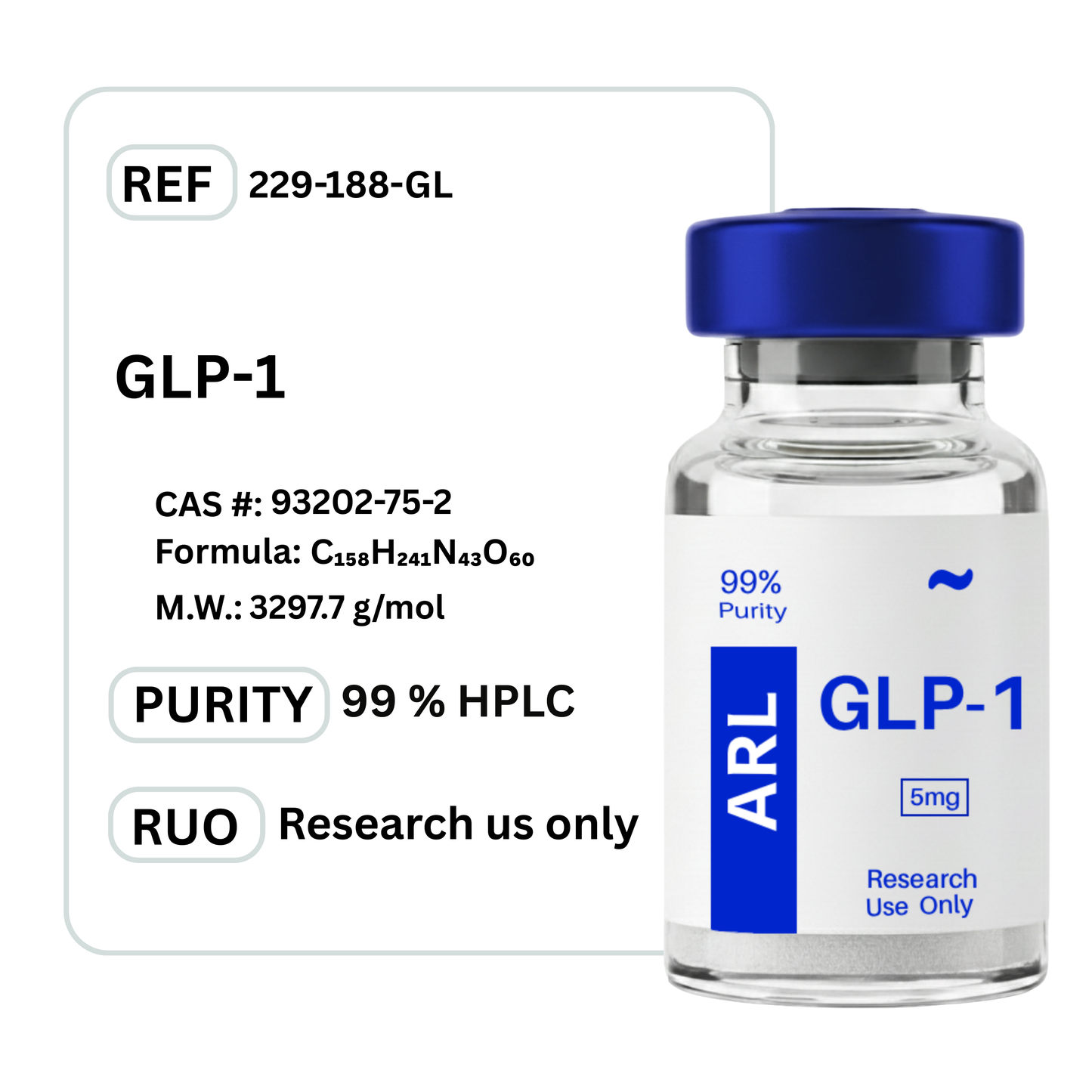
GLP-1
GLP-1
This batch of GLP-1 Peptide has been third party lab tested and verified for quality.
Contents: GLP-1 (Glucagon-Like Peptide-1, Incretin Hormone Analog)
Form: Powder
Purity: 99.3%
Couldn't load pickup availability
Free Reconstitution Solution automatically added to your cart with each order.
This product is Made, Tested & Shipped From United States.
Shipping & Delivery
We are committed to delivering fast, reliable, and transparent shipping for all orders. Please review our policy below for details on delivery times, tracking, and what to expect with every purchase.
View Full Shipping Policy
Verified+

Glucagon-Like Peptide-1 (GLP-1)
1. Introduction and Product Overview
This protocol outlines the use of Glucagon-Like Peptide-1 (GLP-1) as a primary research tool for investigating glucose-dependent insulin secretion and its role in metabolic syndrome. GLP-1 is an incretin hormone with significant physiological effects on glucose homeostasis. Its application in research is crucial for modeling Type 2 Diabetes (T2D) management and exploring underlying mechanisms of insulin resistance.
Product Component
Description
Product
GLP-1 (Glycemic Control Peptide)
Purity
[Purity information]
Storage Conditions
[Storage temperature and duration]
Research Application
Primary tool for investigating glucose-dependent insulin secretion.
Ideal For
Metabolic syndrome and islet cell function studies.
2. Mechanism of Action
GLP-1's therapeutic and research value stems from its dual action on pancreatic islet cells, enabling glucose-sensitive regulation of blood sugar.
2.1 Beta-Cell Enhancement
GLP-1 enhances the responsiveness of pancreatic beta-cells to circulating glucose levels. This action is glucose-dependent, meaning the peptide stimulates insulin secretion only when blood glucose levels are elevated.
- Action: Glucose-dependent stimulation of insulin release.
- Significance: Enables stabilization of blood sugar without the high risk of hypoglycemia seen with non-glucose-dependent secretagogues.
- In Vitro Model Focus: Quantifying enhanced insulin secretion in response to varying glucose concentrations.
2.2 Alpha-Cell Suppression
The peptide actively suppresses the release of glucagon from pancreatic alpha-cells, particularly in a high-glucose state. Glucagon is a counter-regulatory hormone that raises blood glucose, and its suppression contributes to overall glycemic control.
- Action: Suppression of postprandial glucagon secretion.
- Significance: Reduces hepatic glucose output, contributing to reduced overall blood sugar.
- In Vitro Model Focus: Measurement of glucagon levels following GLP-1 administration in high-glucose media.
3. Safety Profile in Research Models
GLP-1 is investigated for its favorable safety profile, specifically its intrinsic mechanism that prevents drug-induced hypoglycemia.
- Key Feature: The action is strictly glucose-dependent. If glucose levels are low, GLP-1 activity is minimal, thus preventing over-stimulation of insulin release.
- Research Implication: Protocols involving GLP-1 can safely explore maximal glucose-lowering efficacy without complex hypoglycemia management, making it an excellent candidate for chronic exposure studies in cell cultures and animal models.
4. Primary Research Applications
GLP-1 is central to two major areas of metabolic research.
4.1 Type 2 Diabetes Management Modeling
GLP-1 protocols are used to simulate modern pharmacological strategies for T2D.
- Protocol Goal: To quantify the rescue effect of GLP-1 on glucose-impaired insulin secretion.
- Typical Metrics: Insulin Secretion Rate (ISR), Glucose Disposal Rate (GDR), and Beta-Cell Glucose Sensitivity Index.
4.2 Insulin Resistance Protocols
The peptide is employed to investigate the improvement of cellular insulin sensitivity, often in models where cells have been intentionally rendered insulin resistant (e.g., high-fat or high-glucose media).
- Protocol Steps:
- Induce insulin resistance in File cellular model.
- Treat with varying concentrations of GLP-1.
- Measure the uptake of radio-labeled glucose (2-deoxyglucose) to assess improved insulin action.
5. Standardized Experimental Procedure (In Vitro Islet Cell Studies)
This procedure provides a template for studies using isolated pancreatic islets or beta-cell lines (e.g., INS-1, MIN6).
5.1 Reagent Preparation
- GLP-1 Stock Solution: Prepare a 1 mM stock solution in sterile water or appropriate buffer.
- Glucose Solutions: Prepare low-glucose (2.8 mM) and high-glucose (16.7 mM) Kreb's buffer.
5.2 Glucose-Stimulated Insulin Secretion (GSIS) Assay
This assay measures the dose-response relationship of insulin secretion to glucose in the presence or absence of GLP-1.
Step
Detail
Key Measurement
1. Islet/Cell Preparation
Culture cells at 37°C until 80% confluence.
Cell Viability
2. Low-Glucose Pre-incubation
Pre-incubate cells for 1 hour in low-glucose buffer (2.8 mM).
Baseline Insulin Release
3. Stimulation Phase
Incubate cells for 30 minutes in high-glucose buffer (16.7 mM) with or without GLP-1 (e.g., 10 nM).
Stimulated Insulin Release
4. Sample Collection
Collect supernatant and immediately process for insulin ELISA.
Insulin Concentration (pM/L)
5.3 Data Analysis and Reporting
Results must be normalized and reported as a stimulation index.
$$
\text{Stimulation Index} = \frac{\text{Insulin in } (16.7 \text{ mM Glucose } + \text{ GLP-1})}{\text{Insulin in } (2.8 \text{ mM Glucose})}
$$
The final report should include a graphical representation of the dose-response curve, including standard errors of the mean (SEM) from at least three independent experiments.
6. Safety and Handling
GLP-1 is a peptide and should be handled with standard laboratory precautions.
- Safety Data Sheet (SDS): Refer to File for detailed safety information.
- Waste Disposal: Follow standard biological waste disposal protocols for peptide solutions.
- Training: All personnel handling the peptide must attend the GLP-1 Research Protocol Training on Date at Place, confirmed by Calendar event.
7. Next Steps and Collaboration
Further research is planned to expand the application of GLP-1 in studies modeling poly-pharmacy treatments for metabolic syndrome. We are actively seeking collaborations with teams focused on the downstream signaling pathways (e.g., cAMP/PKA) activated by the GLP-1 receptor. Please contact Person for collaboration inquiries.Troubleshooting Common Issues
While the GSIS assay using GLP-1 is generally robust, specific issues can impact data quality. Addressing these issues systematically is crucial for reliable results.
8.1 Low Insulin Secretion Rate (ISR)
If the overall insulin secretion is unexpectedly low, consider the following potential causes:
Potential Cause
Suggested Solution
Low Cell Viability
Perform a Trypan Blue exclusion test (or equivalent) before the assay. Ensure cells are no more than P8 (Passage 8) and viability is >90%.
Sub-optimal GLP-1 Potency
Re-constitute a fresh GLP-1 stock solution. Verify storage conditions and confirm the product has not exceeded its recommended stability period.
Inadequate Pre-incubation
Ensure the 1-hour pre-incubation in low-glucose (2.8 mM) media is strictly followed to achieve a proper baseline and maximize subsequent stimulation.
8.2 High Baseline Insulin Release
A high baseline measurement (Step 2) reduces the observable stimulation index and can obscure the GLP-1 effect.
Potential Cause
Suggested Solution
Residual High Glucose
Thoroughly wash the cells (3x) with warm, low-glucose Kreb's buffer after culture media removal and before the 1-hour pre-incubation.
Non-specific Insulin Secretion
Ensure the assay buffer does not contain high concentrations of non-glucose secretagogues (e.g., high potassium, specific amino acids).
- Equipment and Materials Checklist
Prior to starting the experiment, ensure all necessary equipment is calibrated and all reagents are prepared and within their expiration dates.
Category
Item
Verification Check
Equipment
CO2 Incubator
Calibrate Temperature (37°C) and CO2 (5%)
Plate Reader
Calibrate for ELISA detection wavelength
Centrifuge
Check rotor speed and temperature control
Reagents
GLP-1 (Glycemic Control Peptide)
Purity and Storage Conditions Confirmed
Low-Glucose Kreb's Buffer (2.8 mM)
pH (7.4) and Sterility Check
High-Glucose Kreb's Buffer (16.7 mM)
pH (7.4) and Sterility Check
Insulin ELISA Kit
Expiration Date and Standard Curve Quality
Consumables
Cell Culture Plates (e.g., 24-well)
Sterile and Tissue-Culture Treated
Pipettes (P20, P200, P1000)
Calibration Status Confirmed
-

CRYSTAL CLEAR QUALITY
Formulated in regulated, cGMP-compliant facilities.
-

DRIVE-THROUGH DELIVERY
Fast and reliable 3-5 day shipping.
-

AWARD-WINNING SERVICE
Our expert team provides continuous support.
You may also like
-
SAVE 24%Thymosin Alpha-1
Regular price From $79.00Regular price From $79.00 Sale priceUnit price / per$104.0024% -
SAVE 23%Tesamorelin
Regular price From $80.00Regular price From $80.00 Sale priceUnit price / per$105.0023% -
SAVE 26%Sterile Water
Regular price From $14.00Regular price From $14.00 Sale priceUnit price / per$19.0026% -
SAVE 23%SLU-PP-332
Regular price $125.00Regular price $125.00 Sale priceUnit price / per$164.0023% -
SAVE 23%Sermorelin
Regular price From $70.00Regular price From $70.00 Sale priceUnit price / per$92.0023% -
SAVE 23%Retatrutide Triple Agonist
Regular price From $90.00Regular price From $90.00 Sale priceUnit price / per$118.0023% -
SAVE 26%Oxytocin Acetate
Regular price $42.00Regular price $42.00 Sale priceUnit price / per$57.0026% -
SAVE 25%Melanotan II (MT2)
Regular price $50.00Regular price $50.00 Sale priceUnit price / per$67.0025% -
SAVE 24%Lipo-C with B Vitamins
Regular price $85.00Regular price $85.00 Sale priceUnit price / per$112.0024% -
SAVE 23%Lemon Bottle
Regular price $80.00Regular price $80.00 Sale priceUnit price / per$105.0023% -
SAVE 23%L-Carnitine
Regular price $97.00Regular price $97.00 Sale priceUnit price / per$127.0023% -
SAVE 24%KPV Tripeptide
Regular price From $56.00Regular price From $56.00 Sale priceUnit price / per$74.0024% -
KLOW Blend - GHK-CU + TB-500 + BPC-157 + KPV 10mg
Regular price $200.00Regular price $200.00 Sale priceUnit price / per$261.0023% -
SAVE 23%Kisspeptin-10
Regular price From $65.00Regular price From $65.00 Sale priceUnit price / per$85.0023% -
SAVE 23%Ipamorelin
Regular price From $32.00Regular price From $32.00 Sale priceUnit price / per$42.0023% -
SAVE 24%IGF-1 LR3 (Long R3)
Regular price From $40.00Regular price From $40.00 Sale priceUnit price / per$53.0024% -
SAVE 24%Hyaluronic
Regular price $28.00Regular price $28.00 Sale priceUnit price / per$37.0024% -
SAVE 23%HGH Fragment 176-191
Regular price $97.00Regular price $97.00 Sale priceUnit price / per$127.0023% -
SAVE 23%HGH 191AA (Somatropin)
Regular price From $55.00Regular price From $55.00 Sale priceUnit price / per$72.0023% -
SAVE 25%Gonadorelin
Regular price $50.00Regular price $50.00 Sale priceUnit price / per$67.0025% -
SAVE 23%Glutathione
Regular price $83.00Regular price $83.00 Sale priceUnit price / per$109.0023% -
SAVE 23%Glow BPC-157 + GHK-CU + TB-500
Regular price $139.00Regular price $139.00 Sale priceUnit price / per$181.0023% -
SAVE 25%Epitalon (Epithalon)
Regular price From $50.00Regular price From $50.00 Sale priceUnit price / per$67.0025% -
SAVE 24%Dermorphin
Regular price $56.00Regular price $56.00 Sale priceUnit price / per$74.0024% -
SAVE 23%CJC-1295 with DAC
Regular price $139.00Regular price $139.00 Sale priceUnit price / per$182.0023%
Every vial we sell comes from a lab that follows current Good Manufacturing Practices (cGMP). That means each step of production is documented and controlled. Before a batch is released, it’s tested by independent third-party labs for purity, identity, and sterility. Certificates of analysis are available so you can see the exact test results.
Yes. The labs we work with use ISO-certified clean rooms where air quality, equipment, and handling procedures are tightly regulated. Staff are trained to pharmaceutical-grade standards. This ensures the peptides are produced in an environment that minimizes contamination risks.
Peptides in lyophilized (freeze-dried) form are stable at room temperature for transport. Once you receive them, refrigeration is recommended to maintain long-term integrity. We package every order securely to prevent damage and ship promptly, so your vials arrive in optimal condition.
We operate under strict in-house protocols that follow current Good Manufacturing Practices (cGMP). That means our team oversees the entire process from sourcing raw amino acids to the final lyophilized vial. Nothing is outsourced or repackaged. This gives us full control over purity, consistency, and sterility, and it’s why we can stand behind every single vial we ship.
Store them in the refrigerator, away from direct light and heat. If you need to keep them longer, some peptides can be stored frozen. Each vial comes with clear handling instructions so you know the proper conditions for stability.
The strongest proof is transparency. For every peptide, we can provide certificates of analysis, manufacturing documentation, and references to the published scientific research behind it. If you ever have questions, we’ll show you the data rather than ask you to take our word for it.
The difference is transparency. Most sites give you a product name and a price. We provide full batch testing, lab documentation, and direct access to certificates of analysis so you don’t have to guess what you’re getting. When you order from us, you know exactly what’s in the vial, where it was made, and how it was verified.