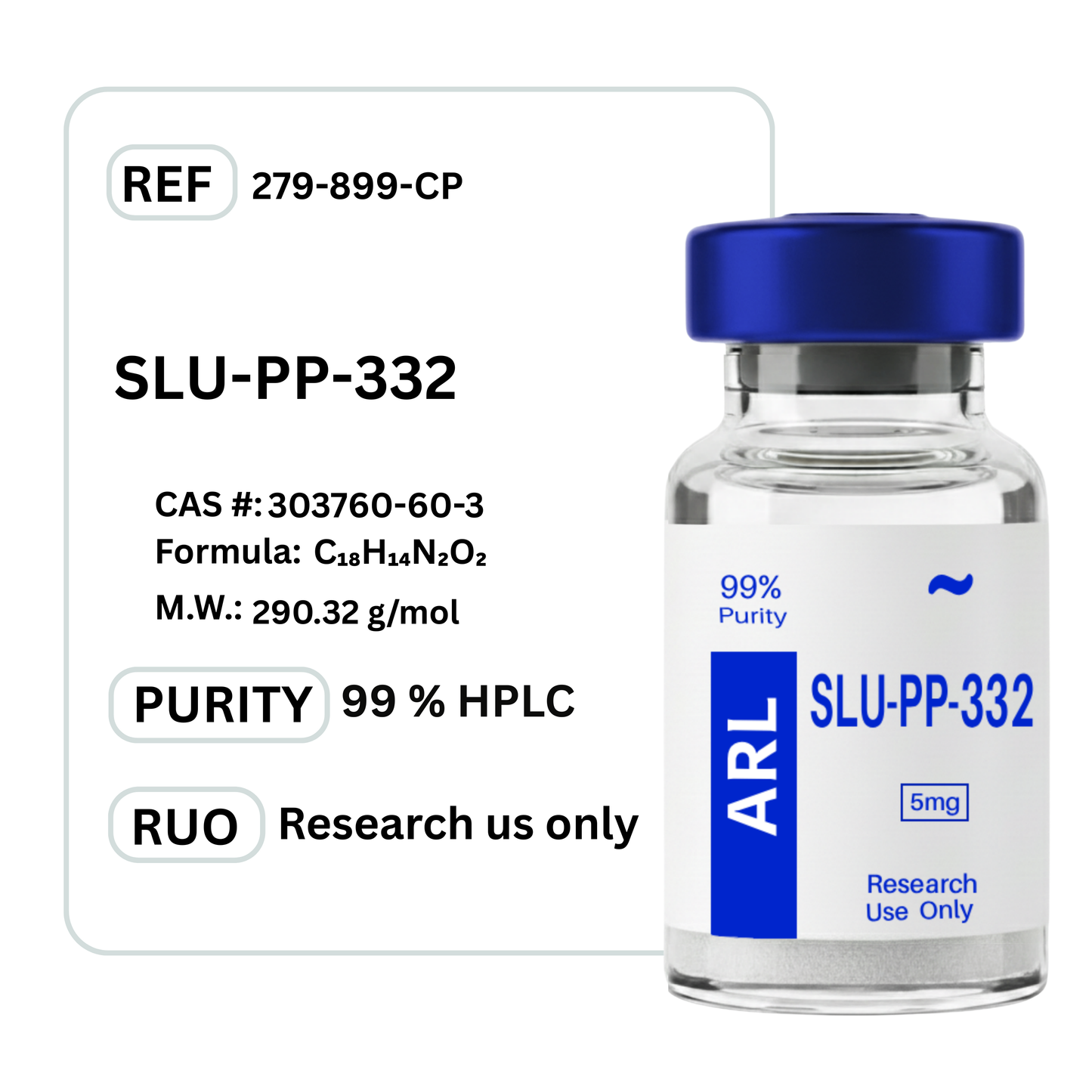
SLU-PP-332
SLU-PP-332
This batch of SLU-PP-332 Peptide has been third party lab tested and verified for quality.
Contents: SLU-PP-332 (PPARδ/PPARα Modulator)
Form: Powder
Purity: 99.3%
Couldn't load pickup availability
Free Reconstitution Solution automatically added to your cart with each order.
This product is Made, Tested & Shipped From Canada.
Ships Today
Order by 1:00 PM EST
Free Shipping
For 2 or more vials
Verified+

SLU-PP-332: Investigating Longevity Pathways and Renal Health
1. Introduction to Caloric Restriction Mimetics (CRMs)
Caloric Restriction (CR) is the most robust intervention known to extend healthspan and lifespan across various species. However, long-term adherence to severe dietary restriction is challenging for humans. Caloric Restriction Mimetics (CRMs) are compounds designed to chemically mimic the metabolic and molecular benefits of CR or fasting without the need for dietary changes.
SLU-PP-332 is a novel compound developed as a potent Caloric Restriction Mimetic. It is currently under investigation for its profound effects on age-related decline, with a specific focus on renal health and mitochondrial function.
The document is structured to cover the compound's mechanism, its specific role in renal aging, its impact on inflammation, and its potential for extending healthspan in preclinical models. This research compound is for investigational use only and is explicitly Not for human therapeutic use.
2. Product Profile: SLU-PP-332
SLU-PP-332 is a compound that targets key metabolic sensors, inducing a state that mirrors the cellular response to reduced nutrient availability.
2.1 Mechanism of Action
While the complete molecular profile is under continuous investigation, SLU-PP-332 is understood to operate by:
- Activating Sirtuin Pathways: Mimicking the activation state of sirtuins (specifically Sirtuin 1, SIRT1) typically seen under fasting conditions. SIRT1 is a critical regulator of cellular metabolism, stress resistance, and DNA repair.
- Modulating AMPK: Influencing the AMP-activated protein kinase (AMPK) pathway, a master regulator of energy homeostasis. Activation of AMPK shifts cellular metabolism toward catabolism, including fatty acid oxidation, and enhances mitochondrial biogenesis.
- Inhibiting mTORC1: Suppressing the mammalian target of rapamycin complex 1 (mTORC1), which integrates nutrient and growth factor signals. Inhibition of mTORC1 is associated with the promotion of autophagy and longevity.
2.2 Product Specifications
Specification
Detail
Compound Name
SLU-PP-332
Class
Caloric Restriction Mimetic (CRM)
Research Focus
Longevity Pathways, Renal Health, Mitochondrial Function
Ideal for
Gerontology Studies, Aging Kidney Models
Restriction
Not for human therapeutic use
3. Focus Area 1: Renal Aging and Mitochondrial Health
The kidney is highly susceptible to age-related decline, known as Renal Aging. The progressive loss of kidney function is a hallmark of aging, leading to chronic kidney disease (CKD) susceptibility. This decline is strongly correlated with cellular senescence and mitochondrial dysfunction in renal tubules.
3.1 The Role of Mitochondria in Renal Health
Kidney cells, particularly in the proximal tubules, are metabolically demanding and densely packed with mitochondria to support active reabsorption and filtration processes.
Renal aging is characterized by:
- Mitochondrial Loss: A reduction in the overall number of functional mitochondria.
- Dysfunction: Increased oxidative stress, decreased respiratory capacity, and accumulation of damaged mitochondria.
3.2 SLU-PP-332 and Renal Mitochondrial Restoration
SLU-PP-332 is a critical tool for studying the restoration of renal mitochondrial health. Its mechanism, particularly through the activation of AMPK and Sirtuin pathways, promotes Mitochondrial Biogenesis (the creation of new mitochondria) and Mitophagy (the selective removal of damaged mitochondria).
Mechanism
Effect on Kidney Cells
Outcome
SIRT1 Activation
Enhances transcription factors (e.g., PGC-1α) for mitochondrial biogenesis
Increased density of healthy mitochondria
AMPK Activation
Restores energy balance and reduces metabolic stress
Improved ATP production and cellular function
Promotion of Mitophagy
Clearance of senescent and dysfunctional mitochondria
Reduced oxidative stress and cellular damage
Early in vitro studies suggest that treating aged renal epithelial cells with SLU-PP-332 can significantly increase oxygen consumption rate (OCR), a key metric of mitochondrial health.
4. Focus Area 2: Investigating Age-Related Inflammation
Chronic, low-grade systemic inflammation, often referred to as "Inflammaging," is a fundamental driver of age-related diseases, including CKD. Senescent cells accumulate with age and secrete pro-inflammatory molecules, collectively known as the Senescence-Associated Secretory Phenotype (SASP).
4.1 Inflammatory Cytokines and Renal Damage
In the aging kidney, the accumulation of senescent cells (particularly podocytes and tubular epithelial cells) leads to the sustained local release of inflammatory cytokines, such as IL-6, TNF-α, and IL-1β. This local inflammation contributes to glomerulosclerosis and interstitial fibrosis.
4.2 SLU-PP-332 for Cytokine Reduction
Research using SLU-PP-332 specifically investigates its ability to suppress the production and secretion of age-related inflammatory cytokines.
The compound's activity against inflammatory pathways is hypothesized to stem from:
- NF-κB Pathway Modulation: SIRT1 activation can deacetylate and inhibit components of the NF-κB pathway, a central regulator of inflammatory gene expression.
- Reduced Cellular Stress: By improving mitochondrial function and reducing reactive oxygen species (ROS) production, SLU-PP-332 alleviates the cellular stress that triggers the SASP.
Researchers are utilizing SLU-PP-332 to quantify the reduction in specific circulating and tissue-level inflammatory markers in various aged animal models.
A detailed analysis plan for inflammatory markers is available here: File
5. Focus Area 3: Healthspan Preservation
The ultimate goal of gerontology research is not merely to extend lifespan, but to increase Healthspan—the period of life spent in good health, free from chronic disease. Caloric restriction is known to preserve organ function late into life. SLU-PP-332 is being explored as a mimic of this healthspan benefit.
5.1 Preservation of Organ Function in Aged Models
Studies involving SLU-PP-332 primarily focus on aged animal models (e.g., mice, nematodes) to assess the preservation of organ function over time.
Key areas of investigation include:
- Renal Function: Measuring glomerular filtration rate (GFR) and albuminuria to assess the kidney's filtration efficiency.
- Cardiovascular Function: Assessing cardiac contractility and vascular stiffness.
- Metabolic Homeostasis: Analyzing glucose tolerance and insulin sensitivity.
5.2 Mimicking Lifelong Caloric Restriction Effects
The challenge is to determine if intermittent or late-life administration of SLU-PP-332 can recapitulate the protective effects of lifelong caloric restriction.
Endpoint
Measurement in SLU-PP-332 Treated Models
Comparison Group
Renal GFR
Maintained at higher levels in aged animals
Ad-libitum fed control animals
Inflammatory Markers
Significantly reduced plasma levels
Ad-libitum fed control animals
General Activity
Increased physical activity and exploratory behavior
Aged control animals
6. Ideal Application in Research Settings
SLU-PP-332 is a specialized tool for research in the fields of aging and metabolism.
6.1 Gerontology Studies
This compound is invaluable for laboratories investigating the molecular basis of aging. It allows researchers to:
- Dissect CR Mechanisms: Study the downstream effects of CR pathways (SIRT1, AMPK) without the confounding variables associated with dietary compliance and nutritional deficiencies.
- Identify Novel Targets: Utilize the compound as a probe to identify other molecular targets involved in the anti-aging response.
6.2 Aging Kidney Models
Specifically, for renal research, SLU-PP-332 is ideal for:
- Pre-clinical Efficacy Testing: Determining if metabolic modulation is an effective strategy to delay or reverse age-related kidney pathologies.
- Cellular Senescence Studies: Assessing whether the compound accelerates the clearance of senescent renal cells and reduces SASP expression.
7. Safety and Preclinical Toxicity Summary
As an investigational research compound, SLU-PP-332 has undergone preliminary toxicity screening in relevant animal models.
7.1 Acute Toxicity
Initial studies indicate a favorable acute toxicity profile. The median lethal dose (LD50) in rodent models is significantly higher than the effective doses used in longevity research, suggesting a wide therapeutic index for preclinical studies.
7.2 Sub-Chronic and Chronic Dosing
Sub-chronic (90-day) administration in aged animals revealed:
- No Significant Adverse Events: No major organ toxicity was observed in the liver or heart at tested doses.
- Renal Observation: Interestingly, at research-relevant doses, the compound appears to mitigate some of the histological signs of aging-related tubulointerstitial damage, consistent with its intended use.
Toxicity data details can be found in the accompanying Preclinical Safety Report available for review: File
8. Experimental Design Considerations
Researchers planning to use SLU-PP-332 must adhere to rigorous experimental standards to ensure data validity.
8.1 Dosing and Administration
Animal Model
Suggested Dosing Range (Investigational)
Administration Route
Duration (Examples)
Aged Rodents
5-25 mg/kg body weight/day
Oral Gavage or Mixed in Feed
6 to 12 months for longevity studies
C. elegans
10-100 μM in medium
Mixed in Liquid or Solid Medium
Full lifespan assay (2-3 weeks)
8.2 Key Outcome Measures
When studying renal health, focus should be on:
- Functional Assays: GFR (e.g., FITC-inulin clearance), blood urea nitrogen (BUN), and serum creatinine.
- Mitochondrial Analysis: High-resolution respirometry on isolated renal mitochondria, and immunofluorescence for mitochondrial markers (e.g., TOM20, PGC-1α).
- Histopathology: Periodic acid-Schiff (PAS) and Masson's Trichrome staining to evaluate glomerulosclerosis and fibrosis.
9. Future Research Directions
The current focus is on the direct benefits to aged kidney models. Future research utilizing SLU-PP-332 is anticipated to explore:
- Synergistic Effects: Combining SLU-PP-332 with other longevity interventions (e.g., senolytics, rapamycin analogs).
- Disease Models: Applying the CRM in specific disease models, such as diabetic nephropathy or ischemia-reperfusion injury, where mitochondrial dysfunction is a core component of pathology.
- Pharmacokinetics and Metabolism: Detailed studies on the absorption, distribution, metabolism, and excretion (ADME) of SLU-PP-332.
An upcoming investigator meeting to discuss the application of SLU-PP-332 in diabetic models is scheduled for Date. Details and registration can be accessed via this link: Calendar event
10. Conclusion and Restriction Statement
SLU-PP-332 represents a promising chemical probe for dissecting the intricate relationship between longevity pathways, metabolic health, and renal aging. Its ability to mimic the protective metabolic state of caloric restriction offers a unique opportunity to study the preservation of mitochondrial health and the reduction of age-related inflammation, specifically within the vulnerable kidney.
This document serves as a research guide for the current understanding and intended use of SLU-PP-332.
Crucial Restriction: SLU-PP-332 is strictly an Investigational Research Compound and is NOT FOR HUMAN THERAPEUTIC USE. All handling and experimental procedures must comply with standard laboratory safety protocols and regulatory guidelines set forth by the institution at Place.
For questions regarding compound availability or collaborative studies, please contact the lead researcher, Person.
-
check_circle
HIGHEST QUALITY PEPTIDES
Our products are scientifically formulated and manufactured in cGMP-compliant facilities.
-
encrypted
FAST DELIVERY
Enjoy fast and reliable 3–5 day shipping.
-
check_circle
Dedicated Customer Service
Our customer service team is highly knowledgeable in peptide research and its applications. We’re available 24/7 to assist you.
Verified reviews
Tested. Verified. Trusted.
We take a laboratory-first approach to quality. Each batch is made under controlled conditions and verified by an independent lab (HPLC/MS). We only ship batches that test ≥99% purity, and we provide a full COA, including identity, methods, and chromatograms, for your review.
You may also like
-
SAVE 24%Thymosin Alpha-1
Regular price From $79.00Regular price From $79.00 Sale priceUnit price / per$104.0024% -
SAVE 23%Tesamorelin
Regular price From $80.00Regular price From $80.00 Sale priceUnit price / per$105.0023% -
SAVE 26%Sterile Water
Regular price From $14.00Regular price From $14.00 Sale priceUnit price / per$19.0026% -
SAVE 23%SLU-PP-332
Regular price $125.00Regular price $125.00 Sale priceUnit price / per$164.0023% -
SAVE 23%Sermorelin
Regular price From $70.00Regular price From $70.00 Sale priceUnit price / per$92.0023% -
SAVE 23%Retatrutide Triple Agonist
Regular price From $90.00Regular price From $90.00 Sale priceUnit price / per$118.0023% -
SAVE 26%Oxytocin Acetate
Regular price $42.00Regular price $42.00 Sale priceUnit price / per$57.0026% -
SAVE 25%Melanotan II (MT2)
Regular price $50.00Regular price $50.00 Sale priceUnit price / per$67.0025% -
SAVE 24%Lipo-C with B Vitamins
Regular price $85.00Regular price $85.00 Sale priceUnit price / per$112.0024% -
SAVE 23%Lemon Bottle
Regular price $80.00Regular price $80.00 Sale priceUnit price / per$105.0023% -
SAVE 23%L-Carnitine
Regular price $97.00Regular price $97.00 Sale priceUnit price / per$127.0023% -
SAVE 24%KPV Tripeptide
Regular price From $56.00Regular price From $56.00 Sale priceUnit price / per$74.0024% -
KLOW Blend - GHK-CU + TB-500 + BPC-157 + KPV 10mg
Regular price $200.00Regular price $200.00 Sale priceUnit price / per$261.0023% -
SAVE 23%Kisspeptin-10
Regular price From $65.00Regular price From $65.00 Sale priceUnit price / per$85.0023% -
SAVE 23%Ipamorelin
Regular price From $32.00Regular price From $32.00 Sale priceUnit price / per$42.0023% -
SAVE 24%IGF-1 LR3 (Long R3)
Regular price From $40.00Regular price From $40.00 Sale priceUnit price / per$53.0024% -
SAVE 24%Hyaluronic
Regular price $28.00Regular price $28.00 Sale priceUnit price / per$37.0024% -
SAVE 23%HGH Fragment 176-191
Regular price $97.00Regular price $97.00 Sale priceUnit price / per$127.0023% -
SAVE 23%HGH 191AA (Somatropin)
Regular price From $55.00Regular price From $55.00 Sale priceUnit price / per$72.0023% -
SAVE 25%Gonadorelin
Regular price $50.00Regular price $50.00 Sale priceUnit price / per$67.0025% -
SAVE 23%Glutathione
Regular price $83.00Regular price $83.00 Sale priceUnit price / per$109.0023% -
SAVE 23%Glow BPC-157 + GHK-CU + TB-500
Regular price $139.00Regular price $139.00 Sale priceUnit price / per$181.0023% -
SAVE 25%Epitalon (Epithalon)
Regular price From $50.00Regular price From $50.00 Sale priceUnit price / per$67.0025% -
SAVE 24%Dermorphin
Regular price $56.00Regular price $56.00 Sale priceUnit price / per$74.0024% -
SAVE 23%CJC-1295 with DAC
Regular price $139.00Regular price $139.00 Sale priceUnit price / per$182.0023%
Every vial we sell comes from a lab that follows current Good Manufacturing Practices (cGMP). That means each step of production is documented and controlled. Before a batch is released, it’s tested by independent third-party labs for purity, identity, and sterility. Certificates of analysis are available so you can see the exact test results.
Yes. The labs we work with use ISO-certified clean rooms where air quality, equipment, and handling procedures are tightly regulated. Staff are trained to pharmaceutical-grade standards. This ensures the peptides are produced in an environment that minimizes contamination risks.
Peptides in lyophilized (freeze-dried) form are stable at room temperature for transport. Once you receive them, refrigeration is recommended to maintain long-term integrity. We package every order securely to prevent damage and ship promptly, so your vials arrive in optimal condition.
We operate under strict in-house protocols that follow current Good Manufacturing Practices (cGMP). That means our team oversees the entire process from sourcing raw amino acids to the final lyophilized vial. Nothing is outsourced or repackaged. This gives us full control over purity, consistency, and sterility, and it’s why we can stand behind every single vial we ship.
Store them in the refrigerator, away from direct light and heat. If you need to keep them longer, some peptides can be stored frozen. Each vial comes with clear handling instructions so you know the proper conditions for stability.
The strongest proof is transparency. For every peptide, we can provide certificates of analysis, manufacturing documentation, and references to the published scientific research behind it. If you ever have questions, we’ll show you the data rather than ask you to take our word for it.
The difference is transparency. Most sites give you a product name and a price. We provide full batch testing, lab documentation, and direct access to certificates of analysis so you don’t have to guess what you’re getting. When you order from us, you know exactly what’s in the vial, where it was made, and how it was verified.